

Of recent, the BBC Africa eye released its report on an investigation conducted where a number of people were killed within Kampala due to the mass demonstrations and riots which had been fueled by the political aggression as the country came close to its presidential elections. It’s disheartening that the country has security departments which have equipment and the basic knowledge to conduct such an investigation but they decide not to or perhaps they waive off the duty to look into the matter, however that maybe a discussion for another day.
With this article I will put into consideration the investigation results curtailed in the video referred to above, the situation at the moment and what the law says about the same.
According to the video clip, the security personnels who were on the police patrol which included policemen and army men (UPDF) in particular were shooting bullets to crowds aimlessly without regard whether they were part of the people rioting or not. Among the people who were affected by the actions of the security men were Kamuyat Ngobi, Amos Segawa,John Amera, Abbas Kalule, John Kitobe among others many of whom lost their lives and a few survived. There is nothing to show that these persons were involved in the rioting and according to by standers these were persons trying to flee from the chaos that was manned all over Kampala.
The Uganda Police together with the Uganda People’s Defence Forces (UPDF) are both organs of the government as per Articles 211(1) and 208(1). Under the National Objective III(i) it’s clearly noted that all organs of the state and people of Uganda shall work towards the promotion of national unity, peace and stability. Its under III(v) that the state shall provide a peaceful, secure and stable political environment for economic development. The question is, in relation to the above were the organs herein acting in promotion of national peace and stability? It’s not doubt-able that the actions were as a result of political aggression, therefore there is no need to put out the second question. You must have the answer by now. Perhaps not to leave this out, the supreme duty of the Uganda Police Force according to Article 212(1) of the Constitution is to protect life and property. I will leave it at that.
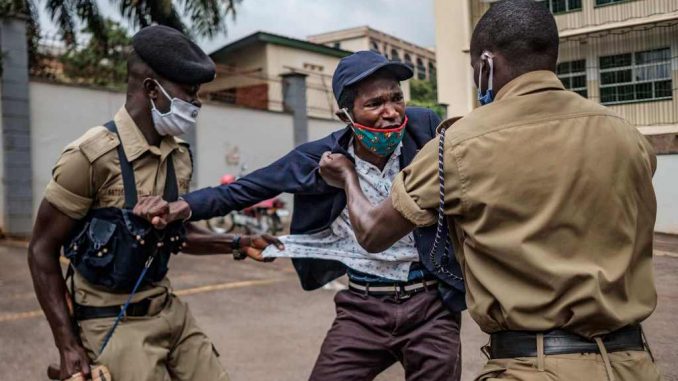
Security operations are always conducted on directions or orders which are always deemed unquestionable as per their standing orders. It’s therefore clear under criminal prosecutions that “superior orders” can always be relied on as a defense by a defendant party. However it was stated by Justice Kisaakye in Uganda v Kadiri Matovu [1983] HCB 27 that “only lawful orders from superior officers would be applicable by inferior officers”. Therefore an officer who complies with unlawful orders from their superior will not be allowed to rely on such as a defense for their crime. With his, I believe this can’t be in anyway justifiable.
This is an indication that in-case the perpetrators were brought to face the article of the law for charges of murder pursuant to Sect 188 and 189 of the Penal Code Act. Unlawfully terminating the life of another is a crime and whoever is involved in it must be held liable, however the perpetrators weren’t identified which makes it had for their prosecution.
This does not mean that’s all, there is another alternative to find justice for these persons. There is a legal principle known as “vicarious liability”, others refer to it as “employers’ liability”. Such liability has been as liability which falls on one person as a result of the action of another person which has caused injury to the third person. (Osborn’s Concise Law Dictionary). Vicarious liability relies on the Latin words “qui facit per alium facit perse” which mean he who acts through another acts for himself. Such liability is available where there exists an employer-employee relationship between the person who has breached their duty and the person or body to be held liable for such breach, an employee is defined as under Section 2 of the Employment Act as any person who has entered into a contract of service including any person who is employed by or for the government of Uganda including the Uganda Public Service, local government but excludes a member of the UPDF. This exclusion brings us to a question that may remain unanswered that incase the assailants were army officials, will such liability be available? You will help me answer that after my next explanation.
THE BBC VIDEO ABOUT THE KAMPALA KILLINGS
CHECK IT HERE
It was clearly stated by court in the Ugandan case of Muwonge v Attorney General [1967] EA 17 by Newbold P “A master is liable for the acts of his servants committed within the scope of his employment…the master remains so liable whether the acts of the servant are negligent or deliberate or wanton or criminal” Accordingly, there are three conditions put into consideration to have such kind of liability applicable and these include that the person must be an employee in the ambit of the law, the employee must have committed a wrong tort and the employee must have been acting within the course of his or her employment and its in these conditions where you find the control test among others which may be of help under the matter at hand.
In a recent case of Kaggwa Vicent v Attorney General (Civil Suit No. 361 of 2014) vicarious liability was applicable where the applicant had been shot and injured by the policemen who had acted negligently. Actually the earlier stated case of Muwonge gives us friendly facts since in the case the Government was held liable for the actions of a police officer who fired bullets during a riot which killed the applicant’s father who wasn’t even part of the riot. Therefore this is where we get back to the other question, if you have been following you must have the answer.
Hajjarah Nakitto a mother to the late Amos Segawa is set to institute proceedings against the government which is of no doubt that she has a cause of action and can be granted remedies.
This article remains subject to opinion and different views are welcome.
 THE LEGAL NOTCH