When a judgment is entered by court, there are different avenues a party aggrieved by the judgment may take to have a chance of the judgment being entered in a different way.
There’s a general rule that the court after passing judgment becomes functus officio and cannot revisit the judgment or purport to exercise a judicial power over the same matter. The slip rule is an exception to this under Section 99 of the Civil Procedure Act that, “Clerical or mathematical mistakes in judgments, decrees o orders, or errors arising in them from any accidental slip or omission may at any time be corrected by the court either of its own motion or on the application of any of the parties”
Where it’s not a clerical or mathematical error then a party may have to appeal the judgment to a higher court, in case the law provides for an appeal. However were there’s no appeal, an application for review of a judgment is an exception to the slip rule.
Just like with a right to appeal, the right to review too cannot be inferred but must be provided for by a statute.
The right to review as of Section 82 of the Civil Procedure Act arises where a party is aggrieved by a decree or order from which an appeal is allowed but from which it has not been preferred or by a decree or order from which no appeal is allowed.
Who then can be regarded as an aggrieved person? In Mohamed Allibhai V W.E Bukenya Mukasa & Departed Asians Property Custodian Board Supreme Court Civil Appeal No. 56 of 1996, Odoki CJ (As was then) explained that a person considers himself aggrieved if he has suffered a legal grievance. And that such a person who is aggrieved may be a party to a suit or any third party may apply for review but such third party must establish that he is an aggrieved person.
Before a judgment is reviewed, there must be grounds for the same. It’s not automatic that where there is no right to appeal then the relevant remedy is review. There must be clear grounds for review before one can lodge an application. (F.X. Mubuke v Uganda Electricity BoardHigh Court Misc. Application No.98 of 2005)
The grounds are herein provided under Order 46 rule 1(b) of the Civil Procedure Rules;
Where there is discovery of new and important matters of evidence previously overlooked by excusable misfortune. This means that this evidence was discovered after exercise of due diligence and it was not within the aggrieved party’s knowledge or could not be produced by him or her at the time when the decree was passed or even the decree made.
Where there is some mistake or error on the face of record. In Edison Kanyabwera v Pastori Tumwebaze, Supreme Court Civil Appeal No. 6 0f 2004, it was held that, “In order that an error may be a ground for review, it must be one apparent on the face of the record, i.e. an evident error which does not require any extraneous matter to show its incorrectness. It must be an error so manifest and clear that no Court would permit such an error to remain on record. The error may be one of fact but it is not limited to matters of a fact and includes also error of law.” Bashaija J in Al-Shafi Investment Group LLC v Ahmed Darwish & Anor (MISCELLANEOUS APPLICATION NO. 901 OF 2017) also explained that; ‘the expression “mistake or error apparent on the face of record” refers to an evident error which does not require extraneous matter to show its incorrectness. It is an error so manifest and clear that no court would permit such an error to remain on the record. It may be an error of law, but law must be definite and capable of ascertainment.’
Where there is any sufficient reason. Court in Re Nakivubo Chemists (U) Ltd[1979] HCB 12 noted that the expression “sufficient” should be read as meaning sufficiently of a kind analogous to the above two grounds. In Baguma v Kadoma [1979] HCB 340 court held that withdrawal of counsel is not a ground for review.
It’s should be noted that the High Court has no power to review its own judgment given on appeal under any special jurisdiction. (Erimiya Serunkuuma v Elizabeth Nandyose [1959] EA 127)
Disclaimer
No information contained in this writing or article should be construed as legal advice from Legal Notch Uganda or the individual authors, nor is it intended to be a substitute for legal counsel on any subject matter.
For additional information in relation to this article, please contact the author.
When a suit is instituted, the process of getting the either party aware about this suit is the objective of a summons and this summons-to-file a defense must be served to that party or parties.
As required under Section 20 of the Civil Procedure Act, when a suit has been instituted then service has to be made upon the defendant or defendants to enter appearance and answer the claim. Same with Order 5 rule 1(1) of the Civil Procedure Rules, when a suit is instituted or has been instituted then summons may be issued to the defendant ordering him to file a defense or ordering him to answer the claim on the day specified therein.
In practice, it’s always the duty of the plaintiff or the applicant to serve the defendant with the summons.
Where a judgment was entered against the defendant without the defendant answering to the claim, its defense enough that summons were not served for court to set aside the judgment. In Busingye & Ors v. Williams Katotsire (2001-2005) HCB 108 it was held that, “The law is that where defendant denies having been served, the onus is on him/her to prove to the satisfaction of court that the service was ineffective.”
Other than mere service, service itself has to be effective. It’s actually supposed to be personal as was put out in Betty Owaraga v. G.W. Owaraga HCCA No. 60 of 1992 but where it is not possible to serve the defendant service can be done on his agent or adult member of his family.
The aspect of effective service was well explained in Gatete v Kyobe & Another Civil Suit NO. 7 of 2005 that service may be good but not effective. With effective basically the person who is served [defendant] should know that there is a suit against him/her so that they file a reply. Therefore where any service is made and the defendant notices of such service then that is effective service. But mere service of summons to the agent, family member, substituted service all fall under good service in that they may not be that good.
About substituted service, it only applies where personal service fails and can only be made after an application to court to have the defendant served by way of substituted service. In Sulaiman Kidandala v Muhammed Ssegirinya and The Electoral Commission High Court Parliamentary Election Petition of 2021, court looked into substituted service and that the party instituting a suit cannot just opt for substituted service before taking the reasonable efforts to serve the defendant personally.
In the same case, the first respondent was in prison and the petitioners claimed that he had refused to receive the summons. However, Order 5 rule 19 of the Civil Procedure Rules provides for service of defendants in prison. That the summons shall be delivered or sent by post or otherwise to the officer in charge of the prison for service on the defendant. So there are rare circumstances where such service could be evaded by the responded, and well it would be good service.
DEVELOPMENT
Evading service is one way parties use to delay suits from proceeding and courts have also been on the look to ensure there’s a way to go past this of course with the developments that have come with technology.
Since suits can be instituted or filed online with the ECCMIS (Electronic Case Management Information System), same with service of summons. Service of summons can now be effected online through the use of social technology.
This development came with the decision in Male Mabirizi v Attorney General Miscellaneous Application No. 918 of 2021 where Justice Musa Ssekaana had this to say, “Like any other modes of service, service by email or Facebook or WhatsApp or any other technologically advanced means are calculated at providing parties with notice of existence of a suit or hearing date for their response or attendance. Service of court process electronically has come to be recognized in Uganda as one of the acceptable means of service through the Companies Act-Section 274 and also recently rules passed by the Rules Committee – The Constitution (Integration of ICT into the Adjudication Processes for Courts of Judicature)(Practice)Directions, 2019.”
With reference to that, Justice Musa Ssekaana found that the court had acted within its powers when it ordered service on the respondent to be effected by email since the respondent was trying to avoid service of court process in order to delay the trial of an application for contempt.
” Service by email or Facebook or WhatsApp or any other technologically advanced means are calculated at providing parties with notice of existence of a suit”
JUSTICE MUSA SSEKAANA
With this development, service made by WhatsApp may be deemed good service as if it were made in person. The question would now be how effective would it be and what does the plaintiff or applicant have to prove before court as evidence of service?
Disclaimer
No information contained in this writing or article should be construed as legal advice from Legal Notch Uganda or the individual authors, nor is it intended to be a substitute for legal counsel on any subject matter.
For additional information in relation to this article, please contact the author
This may not be a topic of debate but all we need is to look into the provisions of the law and find out where the standing could be.
The Osborn’s Concise Law Dictionary defines an appeal as any proceedings taken to rectify an erroneous decision of a court or tribunal by bringing it before a higher court.
The same defines a right as an interest recognized and protected by the law. The only rights of appeal are those that are expressly provided for by the statute. Therefore such a right isn’t one that can be inferred but must be provided for by the law.
Odoki CJ (As he was then) put this clearly well in Baku Raphael Obudra & Another v Attorney General, Constitutional Appeal No 1/2005 when he said, “It’s is trite law that there is no such thing as inherent appellate jurisdiction. Appellate jurisdiction must be specifically created by law. It cannot be inferred or implied”.
“Its is trite law that there is no such thing as inherent appellant jurisdiction. Appellant jurisdiction must be specifically created by law. It cannot be inferred or implied”
odoki cj
The rightful way to put it out is that appeals or the right to appeal is a creature of the statute.
There a various cases that have clearly put this out, where appeals have been denied on grounds of lack of jurisdiction to entertain appeals.
Labour Disputes. It’s now clear that the Court of Appeal is the final appellate court when handling such labour disputes and according to Sect. 22 of the Labour Disputes (Arbitration and Settlement) Act appeals can only lie on a point of law or on a matter of determining whether the Industrial court had jurisdiction over the matter. An appeal cannot lie on any matter other than this which makes it clear that an appeal is only a creature of a statute. Relying on the above provision, the Supreme Court in DFCU Bank Limited v Donna Kamuli Supreme Court Civil Application No. 29/2019 held that the statute does not specifically provide appellate jurisdiction to the Supreme Court from the decision of the Court of Appeal in exercise of its appellate jurisdiction in matters arising from the Industrial Court he there’s no such right to appeal.
Parliamentary Election Petitions. Where a candidate has lost a parliamentary election or actually a dissatisfied voter who has 500 signatures of other voters in the constituency, they could petition the High Court pursuant to Sect. 60(1) of the Parliamentary Elections Act, 2005. The right to appeal the decision of the High Court is provided to the aggrieved person under Sect 66(1) of the Parliamentary Elections Act, 2005 where such appeal is made to the Court of Appeal. According to the 2010 amendment of this act, the decision of the Court of Appeal is regard to Parliamentary Election petitions is final which makes it the final appellate court. It’s now clear that the right to appeal a decision of the Court of Appeal in a parliamentary election petition to the Supreme Court does not exist.
The above discussed are some of the circumstances where the law doesn’t provide for a right to appeal hence reaffirming the fact that a right to appeal is not inherent but rather a creature of the statute.
Disclaimer
No information contained in this writing or article should be construed as legal advice from Legal Notch Uganda or the individual authors, nor is it intended to be a substitute for legal counsel on any subject matter.
For additional information in relation to this article, please contact the author
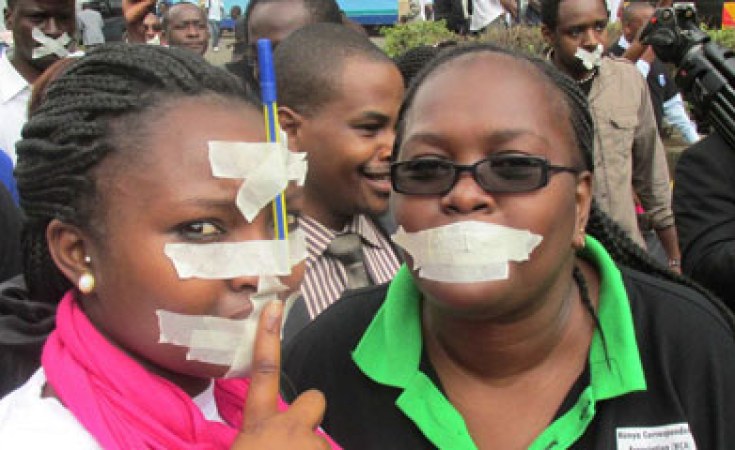
Some of the Ugandan activists rioting against the violation of the freedom of speech recently. (Photo not owned)
Uganda is a democratic country because it has a Constitution which is the supreme law in the country, three arms of government i.e. the Executive, Parliament and Judiciary which all execute their duties “without interference.”
Looking into the human rights of course of the people in Uganda all provided for under the Constitution with the task of ascertaining they are respected being onto the Executive arm according to Article 20(2) of the Constitution and then the Judiciary to hold the Executive or any person responsible where there is failure in respecting one’s right. This power is provided for under Article 50(1) of the Constitution. We however need to note that amongst the rights provided in the Constitution including the right to education, right to privacy, protection of the right to life, among others, none of these are provided by the State or government because all these rights are inherent. We are born with these rights and the duty of the state is to ensure that these rights are respected, upheld and promoted. It’s after there is a failure here that one can run to the courts of law for redress about their rights that have not been protected and hence violated as stated earlier.
My interest here lies in the right or freedom of speech. According to the Constitution of Uganda, every Ugandan has a freedom of speech and expression and accordingly this included the freedom of press and other media. Let’s go slightly into the meaning of “other media”, what’s the Constitution trying to refer to by other media and what actually entails other media. The dictionary meaning is one of a means of communication that reaches a large number of people such as television, newspapers and radio. That maybe an older definition as most dictionaries give an explanation relating to news, however the development currently is that of social media which are basically computer programmes that enable people share information and thoughts with the use of their phones and computers. Now this is where the biggest percentage of the world’s generation is heading to and more so its through social media that most Ugandans are expression their freedom of speech and expression. As of now, Uganda contributes 3.4 million active users with an annual growth of 900,000 thousand users.
With these rising numbers, the biggest percentage is the youth who in someway feel entitled on their right to exercise the right they have and more so the freedom of speech and expression through social media mostly platforms including twitter, Facebook, WhatsApp, among others. This comes with posting anything one feels like and perhaps that’s what the freedom of speech and expression is supposed to cover. But then it goes the other way round that one receives severe and tough replies to a post they made freely; at times these replies are abusive. These same replies do not exclude your standard as a person, even the people deemed most powerful in their country or in power aren’t left aside. And then one will give you a two-way understanding, that even these persons responding are exercising their freedom of speech and expression! So, we have two person or angles from which the freedom of speech and expression is being expressed from, but obviously one will look wrong according to the perspective of the seer. Does this mean there is one violating the other’s freedom of speech and expression!? If it, was one expressing their freedom of speech and expression, does he or she have to give a reply, a comment, a post as rude as that!? Hope this doesn’t bring us to morals, but no it won’t! Does he or she have to keep his identity disclosed!? Perhaps if he is doing the right thing, then why?
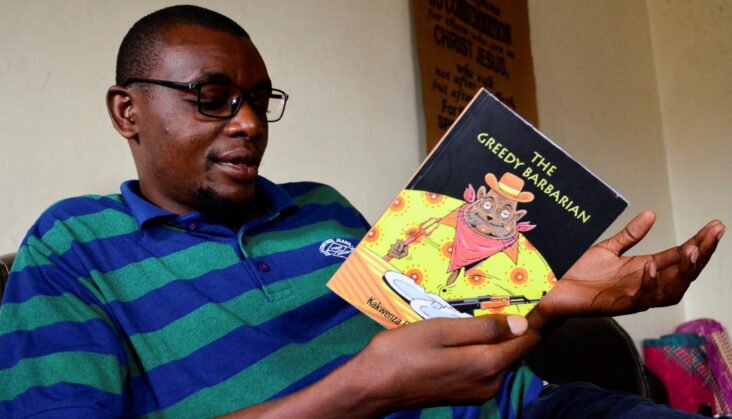
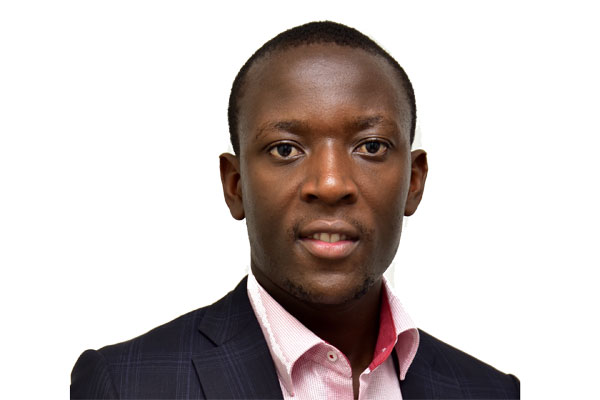
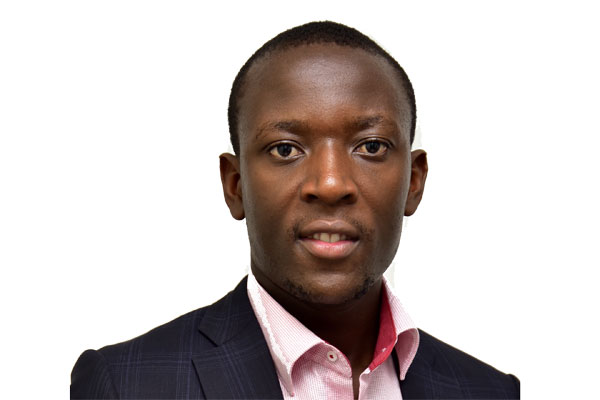
One of the Ugandan writers whose opinion brought repercussions. (Photo not owned)
There’s an answer for each of these questions here, but of course they stand in a different perspective for every individual who would give an explanation. One may say, well the person who replied is right because the information in the post was false, the other may say, well I hide my identity because this country isn’t actually a free country, I don’t know what will happen next to me. I may agree with the last person, but of course its not as constant as it is made to seem like!
You realise that the right to opinion is embedded in the freedom of speech and expression and hence a private right and absolute which is not allowed to be restricted by law or any other power; since it belongs to the realm of the mind. On the other hand, the freedom of expression is a public right hence it impermissible to attempt and close out people’s ideas. As much as it may seem that way, there is nothing like the free will to express “all” ideas you may need to whoever you may need to.
There is the “The Computer Misuse Act” and this cannot be separated from the freedom of speech and expression. Remember this right involves the use of the press or any other media inclusive of social media to express ideas, social media involves the use of computer programmes and these are what we call the social media applications to share information and ideas which means this Act is existence to also manage the use of these. Strait to our point of interest, the expression of ideas on social media and the replies they attract and receive, Section 24 of this Act provides for cyber harassment as a computer misuse offence. Accordingly, this involves making any request, suggestion or proposal which is obscene, lewd, lascivious or indecent or threatening to inflict injury or physical harm to the person or property of any person. On reading this, you actually realise this doesn’t really give a clear image of what most certainly happens on those platforms however what is most disturbing is how authorities use that very provision to issue “threats” or warnings as one may term them to social media users as they go on to use those different platforms. The other is offensive communication also a computer misuse offence provided for under Section 25 of the same Act. The language the Act uses to describe the offence is as “who wilfully and repeatedly uses electronic communication to disturb or attempts to disturb the peace, quiet or right of privacy of any person with no purpose of legitimate communication whether or not a conversation.” Are courts supposed to implore a test for one’s intention to disturb!!?
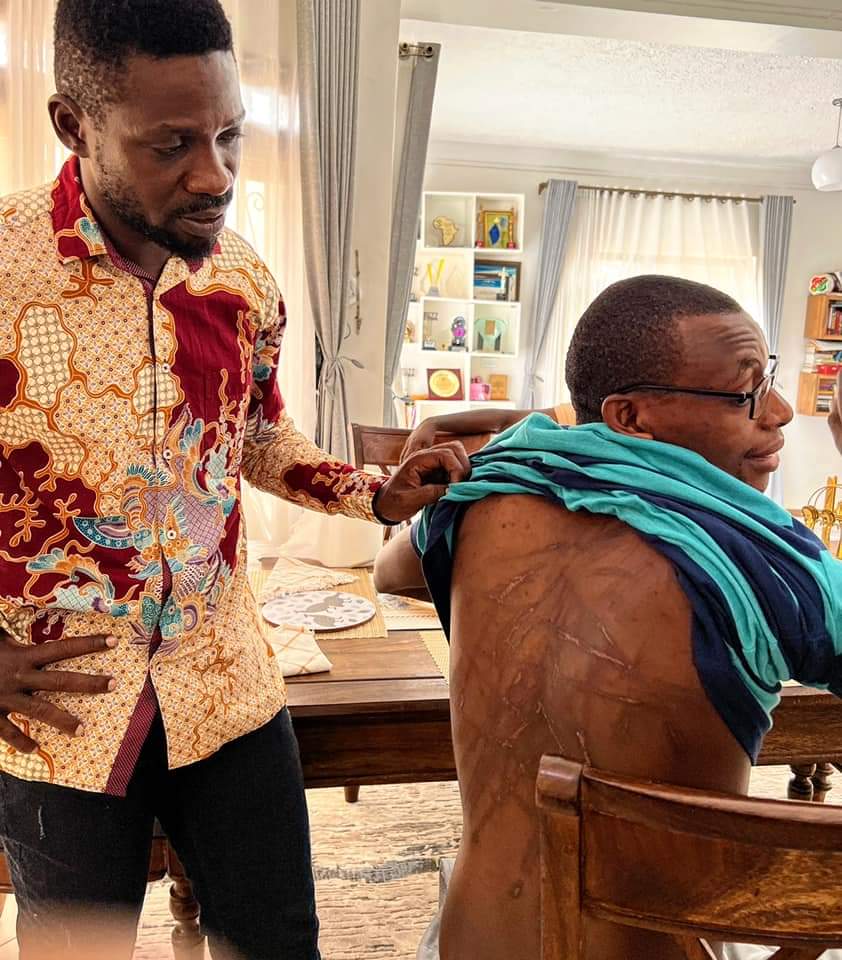
Recently, a profound writer and novelist Kakwenza Rukirabashaija was abducted from his home and later police admitted having him in their custody over offensive custody. But this draws to his tweets which are understood to have been demeaning the personality of the Commander of the Land Forces in the Uganda People’s Defence Forces Lt. Gen Muhoozi Kainerugaba who is also a son to H.E. Yoweri Kaguta Tibuhaburwa Museveni. One’ interpretation of the tweets by Kakwenza maybe that they may be falling under offensive communication but legally they may not, provided the test remains the “intention to disturb” unless the court decides to shy away from that! The form of arrest itself keeps us in doubt as of whether actually the offence here is “offensive communication” or merely a means to placing threats to members of the public who would go the same way as he had and try to attack the personality of the “first son”! Looking into the other offenders, is their arrest as rigid as this is!? I don’t think so!
One of the articles that recently featured in the one newspaper in Uganda.
Away from that, the Uganda Communications Commission (UCC) a body supposed to regulate the communications sector has guidelines in place that are supposed to be followed by telecommunication and media companies. In as much as these guidelines are in place to ensure that standards are followed by these companies, they are instead used to insurge the particular ideas and keep people from expressing their political ideas. Where the guidelines cannot prevent ideas or even block individuals then police or other security organs will! This gets back to the start to doubt the earlier statement of whether actually Uganda is a democratic nation!? One’s answer will have to be based on their understanding and perspective of what is democracy.
Writer Kakwenza showing some of the wounds on his back subject to torture after he had been arrested. (Photo not owned)
But in regard to what we refer to the freedom of speech and expression, a number of victims can be listed and the rest will be upon your personal judgement. In 2019, now former Presidential aspirant Joseph Kabuleeta was arrested for his reply over the President’s tweet where he had awarded high ranked soldiers medals for having attacked Kabamba Barracks in 1981, among the soldiers included now Lt. Gen Muhoozi Kainerugaba who was 7 years by then according to the record. Police referred to the reply as “acidic” and hence an offensive communication because it labelled the president as “a liar.” In February, 2021, police arrested Micheal Muhima, a law student over tweet of a picture of Enanga (the Uganda Police Spokesperson) which was captioned, “We arrested Mr. Kyagulanyi as part of our investigation into Mr. Amuriat’s missing shoes.” The tweet referred to the arrest day of Mr. Kyagulanyi Ssentamu aka “Bobi Wine who was the opposition presidential candidate who had been detained and Patrick Amuriat also a presidential candidate of the Forum for Democratic Change who had been arrested by police but released without shoes. These and many other victims have been subject to confinement in regard to such matters where the people in authority use the available laws as a shield of themselves to avoid criticism of anyway.
And now obviously we have an answer for our question, “the freedom of speech in Uganda, is it limited?” Yes and No. Provided you use such freedom to make personal expressions that do not at any opportunity include or involve the people in government and of course “the big personalities” then there is no way your freedom is curtailed. However, the mere decision by a person to use their freedom to lay a comment about the way the country is run or object on the character of the authorities then such freedom will have to be limited because in our country the law is not the same with everyone “perhaps” as a mere comment to or about someone may not be mere with another.
Like he usually does, Senior lawyer Silver Kayondo has continued giving advice that is supposed to be helpful to young lawyers, fresh law school graduates and also law students.
Many lawyers are advised to upgrade to at least a Master of Laws and many choose to do so from universities abroad. Why do they ignore the local universities and opt for those abroad!!? Is there any advantage in doing so!! Meanwhile do I have to just take on any University so long as it’s in a foreign country!!?
Just like many lawyers, after finishing his Bar Course (LDC) Silver Kayondo worked in Uganda for 2 years in a busy corporate/commercial law firm. “My interest was litigation, but l veened off slowly after seeing cases taking a decade in court”he tweets.
Most lawyers seek for scholarship opportunities once they feel like they need to reconnect for an academic upgrade. He talks about how the right decision should be made.
You’re not supposed to just take on any scholarship simply because an opportunity is available. What if you study things that aren’t applicable in Uganda!! Won’t that be a suicide towards your careers!!? “I had scholarship offers from USA, Europe and China. We had assessed that a big chunk of African action would be Chinese driven…an opportunity came up in South Africa. We went back to the drawing board”.
He notes one major rule in success through qualification, “Rule No.1 – Never be too advanced for your society. You will either end up in very deep trouble (if misunderstood) or fail to fit in and re-adjust…” In other words, as you are making an advancement in regards to your academic qualification, pay much attention to the legal, economic, social developments among others within the country you intend to study in.
Meanwhile, you ought to remember that the time such developments show off in Uganda is so vital to determine whether your qualification choice will render you useful or the other way round.
“Intuitively, I knew Uganda would have to become a “kenya” first and then a “South Africa” before it becomes an “American” or a “Europe”. He added.
Many fresh law graduates among others make the wrong choices when it comes upgrading where upon some choose universities abroad on private or personal sponsorship and others through scholarship opportunities.
To know more why you should not take any scholarship opportunity available read full thread here!!!
How studying abroad pays a huge dividend that keeps compounding- A thread
After the Bar Course (LDC), I worked in Uganda for 2 years in a busy corporate/commercial law firm. My interest was litigation (Court), but I veered off slowly after seeing cases taking a decade in Court. pic.twitter.com/UfbgDaErXb
Silver Kayondo is a senior lawyer and partner at Ortus Advocates (Photo not owned)
The internet of recent has been filled with news about the LDC results where over 90% of the students failed the bar course exam. With the high failure rate, a number of students or lawyers have been left in despair about the next step in their lives moreso towards their carriers. This prompted Silver Kayondo to throw in some advice in regard to his knowledge and experience at the bar of which every young lawyer or law student needs to have a look at before things can go wrong.
For those who dont know whom Silver Kayondo is, perharps the little profile wenhave can helpmyou admit to this. Silver Kayondo is a ugandan and South African dual trained senior lawyer and partner at Ortus Advocates with adverse experience in law, innovation, technology, venture capital and private equity funds. He specialises in legal, policy, transaction and regulatory mandates for financial institutions and emerging technologies. He is a co founder of Drone Nerds Africa. Silver Kayondo holds a Bachelor of Laws(Hons) from Uganda Christian University, a Post Graduate Diploma in Legal Practice from the Law Development Centre, a Masters of Laws(with distinction) from the University of Pretoria, an Advanced Certificate in Insolvency & Restructuring from the South Africa Restructuring & Insolvency Practitioners Association (SARIPA) and Strategic Issues in Leadership in Telecoms, Broadcasting & Postal Regulation from the Public Utility Research Centre(PURC), University of Florida & UCC.
In this very important message posted and summed up in a twitter thread he noted, LDC and the legal profession in Uganda: Theory vs Reality “There is a general belief/perception that Advocates are generally rich and influential people in society. This perception has driven many young lawyers to undertake the Post-Graduate Diploma in Legal Practice Course (LDC)“ Unfortunately, this perception is most times not informed by proper career advice. Matters are not helped by the dogmatic way in which the Bachelor of Laws (LLB) program is structured and delivered in universities, without consideration of career options other than the Bar. Undoubtedly, LLB remains one of the most versatile degrees globally. Even in small economies like ours, that qualification presents numerous career options for its holder across a broad spectrum in business, politics, media, advocacy, activism, research, policy, et cetera. Furthermore, the illusion of wealth is premised on comparison with a very narrow section of Advocates who are “making it big“, but that is not the most accurate representation of the profession as a whole. Young/Junior lawyers need to assess their personal circumstances deeply. To make it as an Advocate requires a lot more than the qualification. Here are a few things they will not tell you in law school;
Your family and social network will play a big part in your early career. These are people who know you and how talented you are. I expound more. Individuals from wealthy families are more likely to have an early boom career because family refers business to them. This also comes along with the right social, political & economic connections to execute the mandates you get. You need to carefully analyse your career strategy.The ugly reality is that you will not make a lot of money in the early years of your career. The first 5 years are for learning. Goes same way for other traditional careers as well. Conservative societies like ours still do not trust young people to do certain big-ticket work. You start gaining market recognition if you are really good and are enjoying a niche market. Fields like tech are awesome because they have low barriers of entry, but they are also arenas of mostly young people. They are peer driven and very democratised. Reason I put 80% here.
Exposure. No professional can be better than the exposure he/she gets. Small economies= little exposure. When you solve small problems, you earn small money. Even the Bar where many are clamouring to come is very crowded. There is backlog of Advocates still finding their foot. I do not say this to discourage colleagues who aspire and genuinely want to join the Bar, but to point out that as you form your aspiration and pursue it, a lot more has to go into it. Everything has an opportunity cost and the little that is there is fiercely fought for. When the Ugandan Bar created challenges for colleagues, some went to Kenya. That caused some shifts in lucrative cross-border work. Multinationals that set up regional offices in Nairobi do not need to hire Ugandan law firms. They just hire these dual-trained lawyers in-house. Some Kenyan-based law firms have also hired this Ugandan talent. They also have English and US trained lawyers on their teams. This makes them more global and competitive in the eyes of international clients who have the big-ticket mandates for corporate & commercial work. I have been thinking deeply about these issues because I think a new type of leadership and perspective is required to create decent opportunities for most of our colleagues. It can be done, but we need a fresh prism/lens on the nature and quality of ecomonic value we can add. Nothing is disheartening to both parents & young professionals like being elevated to a certain level and then the carpet is pulled away. I’ve met folks who say they first wore a suit and a tie for the first time in their lives while at law school. Imagine failing to sustain this.
Professional structure. We are running a fused profession at the moment. We do both Solicitor and Advocates work. This has its challenges, even from a training perspective. I believe that a solution can be crafted for colleagues who have LLB but want to focus on Solicitor work.
Conclusion. The profession is undergoing a lot of change and scrutiny. Legal training is lagging behind the market expectation. 19th century mercantilism and rote learning are being questioned by 21st century agility. Take charge. You are on your own in this. Make it work.
There are very many perceptions that young lawyers or even law students take on to believe not knowing the truth about the legal practice, i believe if you have clearly ready then you are somewhere. Just like Robert Kirumira, a lawyer and lecturer at Makerere Law School told the students who passed the bar course “you have just passed the course and not the bar“.
HERE IS THE THREAD;
LDC and the legal profession in Uganda: Theory vs Reality
There is a general belief/perception that Advocates are generally rich and influential people in society. This perception has driven many young lawyers to undertake the Post-Graduate Diploma in Legal Practice Court (LDC)
One of the victims being saved by two people (Photo not owned)
Of recent, the BBC Africa eye released its report on an investigation conducted where a number of people were killed within Kampala due to the mass demonstrations and riots which had been fueled by the political aggression as the country came close to its presidential elections. It’s disheartening that the country has security departments which have equipment and the basic knowledge to conduct such an investigation but they decide not to or perhaps they waive off the duty to look into the matter, however that maybe a discussion for another day.
With this article I will put into consideration the investigation results curtailed in the video referred to above, the situation at the moment and what the law says about the same.
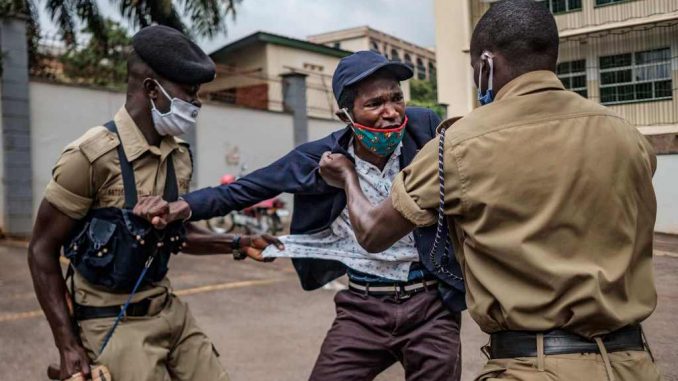
According to the video clip, the security personnels who were on the police patrol which included policemen and army men (UPDF) in particular were shooting bullets to crowds aimlessly without regard whether they were part of the people rioting or not. Among the people who were affected by the actions of the security men were Kamuyat Ngobi, Amos Segawa,John Amera, Abbas Kalule, John Kitobe among others many of whom lost their lives and a few survived. There is nothing to show that these persons were involved in the rioting and according to by standers these were persons trying to flee from the chaos that was manned all over Kampala.
The Uganda Police together with the Uganda People’s Defence Forces (UPDF) are both organs of the government as per Articles 211(1) and 208(1). Under the National Objective III(i) it’s clearly noted that all organs of the state and people of Uganda shall work towards the promotion of national unity, peace and stability. Its under III(v) that the state shall provide a peaceful, secure and stable political environment for economic development. The question is, in relation to the above were the organs herein acting in promotion of national peace and stability? It’s not doubt-able that the actions were as a result of political aggression, therefore there is no need to put out the second question. You must have the answer by now. Perhaps not to leave this out, the supreme duty of the Uganda Police Force according to Article 212(1) of the Constitution is to protect life and property. I will leave it at that.
One man in confrontation with two police officers (Photo not owned)
Security operations are always conducted on directions or orders which are always deemed unquestionable as per their standing orders. It’s therefore clear under criminal prosecutions that “superior orders” can always be relied on as a defense by a defendant party. However it was stated by Justice Kisaakye in Uganda v Kadiri Matovu[1983] HCB 27 that “only lawful orders from superior officers would be applicable by inferior officers”. Therefore an officer who complies with unlawful orders from their superior will not be allowed to rely on such as a defense for their crime. With his, I believe this can’t be in anyway justifiable.
This is an indication that in-case the perpetrators were brought to face the article of the law for charges of murder pursuant to Sect 188 and 189 of the Penal Code Act. Unlawfully terminating the life of another is a crime and whoever is involved in it must be held liable, however the perpetrators weren’t identified which makes it had for their prosecution.
This does not mean that’s all, there is another alternative to find justice for these persons. There is a legal principle known as “vicarious liability”, others refer to it as “employers’ liability”. Such liability has been as liability which falls on one person as a result of the action of another person which has caused injury to the third person. (Osborn’s Concise Law Dictionary). Vicarious liability relies on the Latin words “qui facit per alium facit perse” which mean he who acts through another acts for himself. Such liability is available where there exists an employer-employee relationship between the person who has breached their duty and the person or body to be held liable for such breach, an employee is defined as under Section 2 of the Employment Act as any person who has entered into a contract of service including any person who is employed by or for the government of Uganda including the Uganda Public Service, local government but excludes a member of the UPDF. This exclusion brings us to a question that may remain unanswered that incase the assailants were army officials, will such liability be available? You will help me answer that after my next explanation.
THE BBC VIDEO ABOUT THE KAMPALA KILLINGS
CHECK IT HERE
It was clearly stated by court in the Ugandan case of Muwonge v Attorney General[1967] EA 17 by Newbold P “A master is liable for the acts of his servants committed within the scope of his employment…the master remains so liable whether the acts of the servant are negligent or deliberate or wanton or criminal” Accordingly, there are three conditions put into consideration to have such kind of liability applicable and these include that the person must be an employee in the ambit of the law, the employee must have committed a wrong tort and the employee must have been acting within the course of his or her employment and its in these conditions where you find the control test among others which may be of help under the matter at hand.
In a recent case of Kaggwa Vicent v Attorney General (Civil Suit No. 361 of 2014) vicarious liability was applicable where the applicant had been shot and injured by the policemen who had acted negligently. Actually the earlier stated case of Muwonge gives us friendly facts since in the case the Government was held liable for the actions of a police officer who fired bullets during a riot which killed the applicant’s father who wasn’t even part of the riot. Therefore this is where we get back to the other question, if you have been following you must have the answer.
Hajjarah Nakitto a mother to the late Amos Segawa is set to institute proceedings against the government which is of no doubt that she has a cause of action and can be granted remedies.
This article remains subject to opinion and different views are welcome.
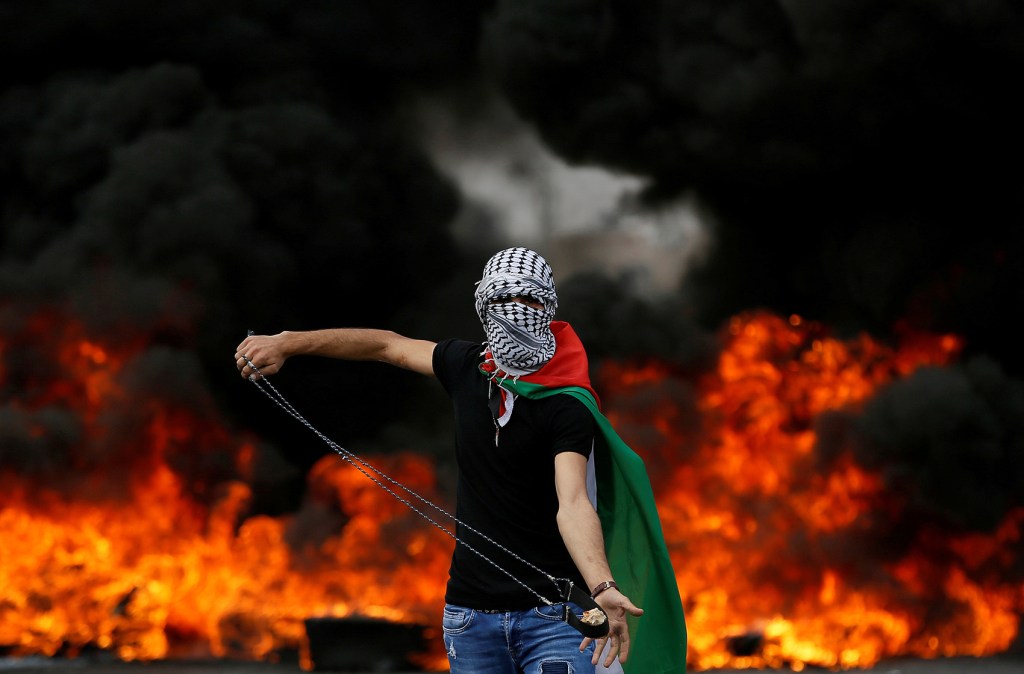
A Palestinian demonstrator holds a sling during a protest marking the 70th anniversary of Nakba, near the Jewish settlement of Beit El, near Ramallah, in the occupied West Bank May 15, 2018. REUTERS/Mohamad Torokman
The debate should not be upon the duties and obligations of the United Nations as they are very clear at least to anyone, one can even guess where they aren’t aware. There was a time where the world was full of warfare and perhaps the worldly leaders then felt it reasonable to have a unifying body that will oversee all this and prevent aggression amongst different states, this is how the League of Nations came about. But perhaps because of its failure, it had to be rebuilt into the United Nations. Of course the United Nations coming as a rebuild of the League of Nations is a complete note that it had to be better, actually far better in its maintenance of worldly peace more so where it gets to peace among member states. Accordingly, all member states of the United Nations have to subscribe to the United Nations Charter and by subscribing it means abiding by the provisions there in. According to Article 1 of the United Nations Charter, the principle obligation of the United Nations is to ensure the observance of international peace amongst member states and to take effective collective measures for the prevention and removal of threats to the peace. Member states are urged to refer to peaceful means in case there are any conflicts among themselves rather than going in for warfare. This is what is usually referred to as “the prevention for the use of force” and all this is composed under Article 2 of the United Nations Charter. It’s therefore clear that it’s only on rare occasions where the UN lets member states go scotty free where they have used force among other states according to its charter. That lets us to the purpose of the Security Council and the United Nations General Assembly, what about them!! Their duties aren’t that different as the major obligation still is to ensure the maintenance of international peace. It’s these bodies that form up the United Nations and of course hold the blame where the United Nations is seen to let loose.
It’s undisputed that on a number of times the United Nations has failed on its major obligation of maintaining international peace. Member states seriously threatening international peace at times luring it down and getting involved in warfare at times directly or even indirectly, in Libya in the overthrow of Libyan dictator, the aggression there by various European countries into that serious war cannot be left unnoticed, the war in Syria, India-Pakistan conflict no complete peace yet, Israel-Egypt conflict in 1979 and now Israeli-Palestinian conflict
Perhaps this time the weakness of the United Nations is being blown out by the serious aggression but even with this kind of it, is the war fare itself justifiable? Who is to blame anyway? Or anyway is there blame to cast on anybody? What should the United Nations have done to stop the happening of it? Could it have done anything even?
A number of questions may arise but perhaps I can try to integrate in the best way I can in regard to my understanding of international law.
In 1947 through the United Nations resolution known as the Partition Plan which sought the division of the British Mandate of Palestine into Arab and Jewish states which led to the creation of the State of Israel on 14th May, 1948. The creation of the state of Israel sparked off the first Arab-Israel war for which the war led to the division of the territory into three parts inclusive of State of Israel, the West Bank and the Gaza Strip.
A number of wars have surrounded this territory for which the United Nations seemed out of control inclusive of 1956 Suez Crisis which was between Israel against Egypt, Jordan and Syria, in 1967, in 1973 in what was known as “Yom Kippur War”. Thou with various peace treaties, more conflicts spark off leaving a number of victims in the territory. A military confrontation between the Israeli Military and the Hamas occurred in 2014 where the Hamas fires rockets at Israel and Israel too retaliated but at the end of all that it’s stated that 73 Israelis and 2,251 Palestinians were killed. Still in 2018 fight broke out between the Hamas and the Israeli Military where rockets were fired from Gaza into Israel, Israel too responded with strikes into Gaza.
Not so different from any of those, the conflict is back where strikes are laughed from Gaza to Israel and from Israel to Gaza.
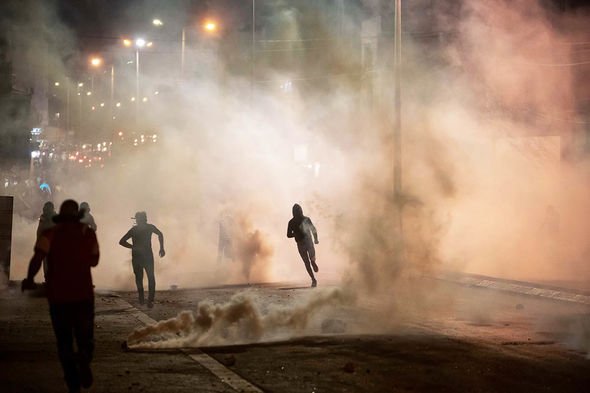
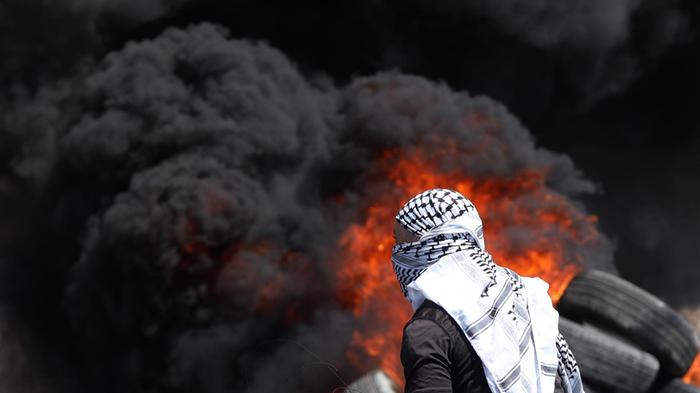
A rare pic of Palestinian demonstrators (Photo not ours)
Perhaps anyone may wonder who the Hamas are, featuring at the center of all these conflicts. Well the Hamas are regarded as a Palestinian militant group that controls Gaza. It disapproves all peaceful settlement with Israel and have on a number of encounters escalated conflicts between the Israelis and the Palestinians.
The major issues of conflict rotate around the city of Jerusalem where both the Israelis and Palestinians have interest, Palestinian statehood as the Palestinians want an independent state including the West Bank, Gaza and East Jerusalem, Israel’s recognition by the Palestinians that isn’t a ‘a national state of Jewish people’, about the borders, settlement of Israelis what are regarded as Palestinian territories, Palestinian refugees who displaced by the creation of the State of Israel.
In a statement about the conflict, UN reminded the parties to the conflict that “any discriminate targeting of civilian and media structures violates international law and must be avoided at all cost”. Should we say it’s all right for the conflict to go on so long as civilians aren’t targeted?
Israel has always based its airstrikes on a self-defensive motive after strikes from the Hamas. The International Court of Justice(ICJ) in its ruling over the known Nicaragua case helped us understand where self-defense broader from the mere provision of it under Article 51 of the United Nations Charter as its claimed by Israel can be an exception to the provision of the Charter where upon a member state resorts to the use of force. It was put clear that for a state to claim it was in use of a right to self-defense then such a state must have been the victim of an armed attack and such a state must declare itself a victim of an armed attack. The state then needs to report to the Security Council that an armed attack happened “as the absence of a report maybe one of the factors indicating whether the State in question was itself convinced that it was acting in self-defense”
Where the Hamas or the Palestinians based in the West Bank launch airstrikes against Israel is a clear indication of an armed attack of the State of Israel but where Israel declared itself a victim of an armed attack or whether it made a report to the UN Security Council all remains a question of fact.
Is the force used by the Israeli military relatable to the attacks on it or it’s far beyond.
Isn’t self-defense a mere excuse to the use of force, are the Israel attacks on the Palestinians justifiable!!? That may be a question according to perspective.
One of the Palestinians rioting next to the Gaza strip (Photo not owned)
The justification of self-defense has been noted in what has been referred to as the Caroline Doctrine in 1837 when US Secretary of State Daniel Webster noted before reaching a conclusion that the British interruption of the Caroline voyage did not qualify as self-defense because self-defense is only justified “if the necessity of that self-defense is instant, overwhelming, and leaving no choice of means, and no moment for deliberation”. This may seem as an old rule but it fully gives justification to the actions of Israel. However they still seem overweight to what was required. Israel could not give any kind of patience to the attacks made on them, so we can say these attacks are at the point were justifiable so Israel isn’t to blame to some extent. And if it’s not to be blamed then who has to, of course the source of the attacks. I believe I have answered the question as to who to blame for the attack. It must be the Palestinians only because Israel is acting in self-defense “at the moment” (emphasis added).
With regard to the gravity of the force used by the Israeli forces on the Palestinians, is such force justifiable as a way of self-defense or the force used was over and beyond. That’s a questions I believe is dependent on personal perspective and so I won’t answer.
Getting to the United Nations, how is it to blame. From the start onto the creation of the State of Israel a completely Jewish nation into an Arabic (Palestinian) territory was the first mistake made upon the resolution of the United Nations and it’s not surprising that conflicts started there on in regard to its creation. The United Nations in 2019 through a resolution of the General Assembly accorded to Palestine a non-member observe state status in the United Nations which is regarded as “de facto recognition of the sovereign state of Palestine” and have some member states recognized it as an independent state. However there still remains a variety of views regarding the status of the Legal Status of Palestine both among the International Community and legal scholars.
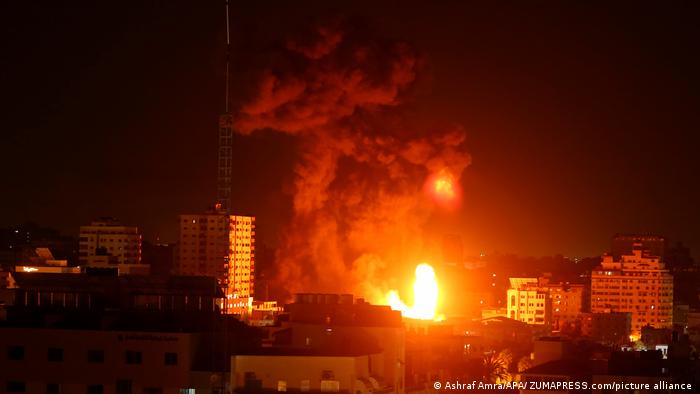
The West Bank on fire after Israel strikes (Photo not owned)
Its clear there lays a blame on the United Nations on the fully recognition of the state of Palestine and its borders with the State of Israel as it’s the major essence of the conflicts.
In addition, the UN Security Council is put in place to handle situations where international peace and security is threatened, this means that required actions should be put up to stop any such conflict from getting into any armed nature. Unless otherwise, the UN carries a blame on failing in its duties. But I noted up, the weight of force used by Israel as a way of self-defense is way higher compared to the attacks made on them. Could we clear it out as being an action taken in self-defense? Should we blame Palestine for inciting the armed attacks on Israel that are now backfiring? Or what, the UN!? You realize that every side in this conflict carries a blame and of course the UN is also a side in the conflict by the act that it has been trusted to be the guardian of international peace and security.
However, all this is relatable to my perspective. This article is however open to discussion and I surely welcome all sorts of arguments, supplements or any kind of arguments.
Way back Ugandans have been lured to think that the male gender can never be subject to sexual harassment or even sexual violence. Uganda is a country where people are regrouped into tribes and communities backed by their by heir various beliefs, most of these have it placed in that the man in a home is the head and therefore decides what happens in the home however this has changed over time and with it many tings have changed.
Social media currently is the basis of all kind of activism and filled with many feminist who are always trying to prove a point in regard to the way the female gendeeer is treated. However all these have failecd on one thing, where there is always an incident where a man has been subject to what may be called sexual hasshment of which it as been imputed by a female they all remain silent and they fail to condemn such an act. What does this mean? I think it means that most of these so called ‘feminits’ aren’t activists to for women’s rights or even speaking out fr their justice but rather individuls using such incidents as a stepping stone to heir own previllege.
Lets start with the incident that rolled all media platforms where some ‘girls’ were accusing once city tycoon Brian Kirumira alias ‘Brain White’ that he sexually harrased them on various occassions but just like me many don’t know how that scandal came to an end. Many feminists rose up and claimed to be fightin g for the rights of these girls even when the facts the were providing were inconsistent. Not even a week later, one young man whose names i didnt capture stormed twitter with a heartbreaking story of how some girl also a studnt of ‘Mubs’ had drugged him up and went ahead to do with him everything she wished to do as the young man was laying down unconsious. The story was a sorrowfukl one and it surely went viral to the various media platforms. One may be wondering where the so called ‘feminists’ were to condemn such an act, whether the facts the young man was providing were inconsistent shoudn’t be an excuse becau8se so werer the facts in the first incident.
The feminists aside, the most worrying part is that the laws in our country do not even habve such incidences covered meaning the culprits will surely run aware free like nothing did happen. Its also had for men to convice the public tjhat such incidences can happen to them since its clear in uch matters the public will be the court as no courts will entertain matters not coverred under the law. For the femles, its so easier for tem to plead for mercy and for the public to believe they cannot commit such acts to men who arwe taken to be stronger.
Sect. 123 of the Penal Code Act of Uganda puts it clear that for the offence of rape to rape to stand there must have been a penetration of the victim by the offender without the victim’s consent. It i therefore clear that its only a woman who can be penetrated as the penetration provided for is one where the penetration has been made into the sexual organ which isn’t possible for a man. This therefre mean that a man cannot be rapped as per the laws in uganda.
The only way where one can claim safely a case on the sidee of the male vistim is through Sect. 129 of the Penal Code which provides for defilement and this surely catters for male victims who ar referrred to as children in the ugandan law henc the adult males remain not covered. A few months back in Masindi, a wman was caught red anded commitin ga sexual act with a very young boy. After her arrest,a number of parents approximately six reported complaints of sexul harrashment of their childeren by the same woman. This is therefore the level at which the male ender is getting subject to harrashment under the disguise the female gender is a weak one and motherly which cannot commit such acts.
The quetion to many is how does such an act happen? This is a question that i can’t stand to answer to its entity because am not a victim in any way hence the right person to answer such a questopn would be a victim to sexual harrashment where the offender ha been a female.
Such actions will still happen and be on the rise not until this loophole in the law ha been covered such that the male gender may also be counted safe under such conditions.
Since it’s independence, Uganda has evolved through different regimes all of which stood with their merits and demerits. Many of these regimes were characterised with the abuse of human rights but the reason behind this was that many of these forcefully came into power just as the current one. However the difference is that elections have between held and the NRM government has come out victorious.
A constitution was drafted hoping it will hold the will of the people as it provided different human rights. However, their violation has more so reached it’s pick at such a time when no appointment has been made to Chair the Uganda Human Rights Commission after the passing away of Meddie Kaggwa(R.I.P). Article 29(1)a and b of the Constitution (As Amended) provides for the right to the freedom of speech and expression, freedom of thought, conscience and belief but the question is how do we interpret these rights. We expect that the Constitution being the supreme law in this country, it’s provisions stand paramount to be followed but it’s instead the other way round.
On the 25th July 2020, four members of a comedy crew alias ” _Bizonto_” who were also employees of Simba FM were arrested with their arrest being connected to a video clip they released. In the video clip all the top government officials mentioned there in were said to be coming from the west which was absolutely true, thou it’s stated that they were intending to mean the government is tribalistic. I don’t think it should be a crime interpreting someone’s message the other way round. Neither is it a crime to come from the West, Article 37 of the Constitution provides for a right to belong to a certain culture.
Before the incident above on the 23rd, a musician ” _Gerald Kiweewa_” was arrested and had his house arrest in relation to a song he had released a while ago titled ” _Nantaba_ “. It is allegedly said it’s because a name of a certain Minister is mentioned and added up to a name an opposition member of Parliament but still connecting to some rumours back then which I won’t dig into. It’s not the first arrest made of an artist because someone isn’t happy with what they did mention in the profess of their music.
In 2005, the Constitutional Court annulled provisions of the Penal Code Act which incriminated sedition just because they were inconsistent with Article 29 of the Constitution and these included Sections 39 & 40. This was in the case of Andrew Mwenda & Another v The Attorney General, Constitutional Petition No.12 of 2005 where court agreed with Counsel Kakuru (As he was then) that leaders ought to grow hard skins to bear certain criticism instead of using their power to violate people’s freedoms.
My understanding is that there is no crime I commit when you interpret my message in a wrong way so different from what I actually intended to mean. Seriously, this isn’t where you should apply your ” _innuendo_ ” or else we may put the law to fault. There as I conclude, the country is set to hold scientific elections first of their kind meaning as much criticism is expected, will the government end up arresting everyone that opens their mouth to speak against something they think is wrong!!?






 THE LEGAL NOTCH